World Food Day 2026
Ghana Must Innovate Not Only to Produce More Food, but to Keep It Safe and Nutritious
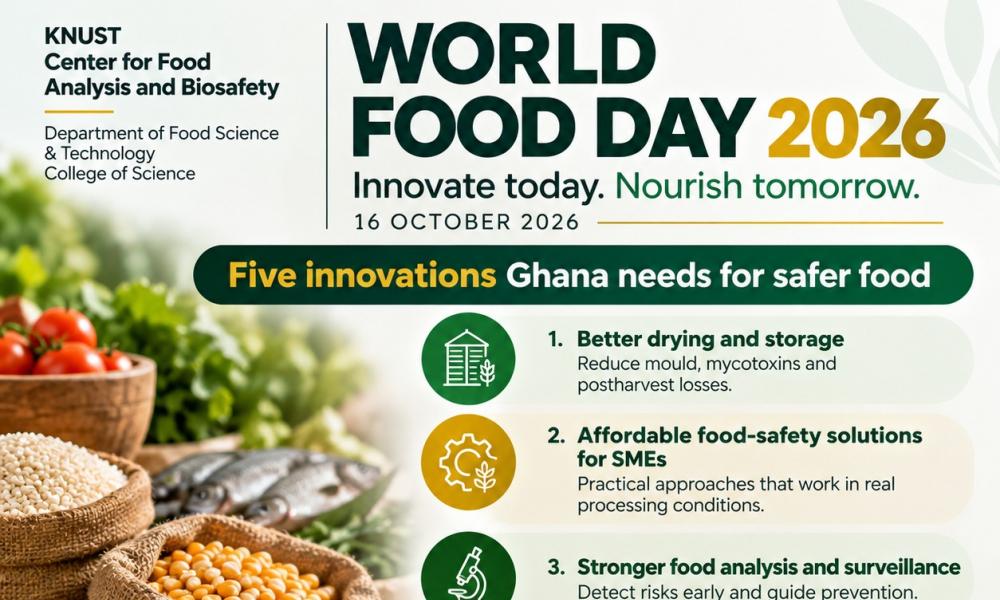
As Ghana joins the global community to mark World Food Day 2026 under the theme “Innovate today. Nourish tomorrow,” the KNUST Center for Food Analysis and Biosafety calls for food safety, nutrition and scientific evidence to be placed at the heart of the country’s food-system innovation agenda.
Innovation in food systems is often associated with increasing agricultural production. Producing more food is undoubtedly important. However, a truly resilient food system must also ensure that the food produced reaches consumers safely, retains its nutritional value, meets appropriate quality standards and is protected from avoidable losses.
This year’s World Food Day theme is particularly relevant to Ghana. Innovation does not have to mean expensive or highly sophisticated technology. It can include better drying and storage of cereals and nuts, improved hygiene during processing, safer preservation of fish and other foods, better traceability, affordable testing methods, improved packaging, stronger surveillance systems and more effective use of data to prevent problems before they reach consumers.
At the same time, emerging analytical technologies, digital systems and modern approaches to risk assessment provide Ghana with opportunities to strengthen how we identify and respond to food-safety challenges. Risks such as microbial contamination, mycotoxins, pesticide residues, heavy metals and other contaminants cannot be managed effectively without reliable evidence. Food analysis should therefore not simply be viewed as a test performed when something goes wrong. It should increasingly become part of a preventive system that supports farmers, processors, regulators, public-health authorities and consumers to make better decisions.
Our food-security conversation must also recognize that food that is unsafe cannot deliver food security. Similarly, sufficient calories alone do not guarantee good nutrition. Innovation must help us produce foods that are safe, diverse, nutritious, affordable and appropriate for the needs of our population.
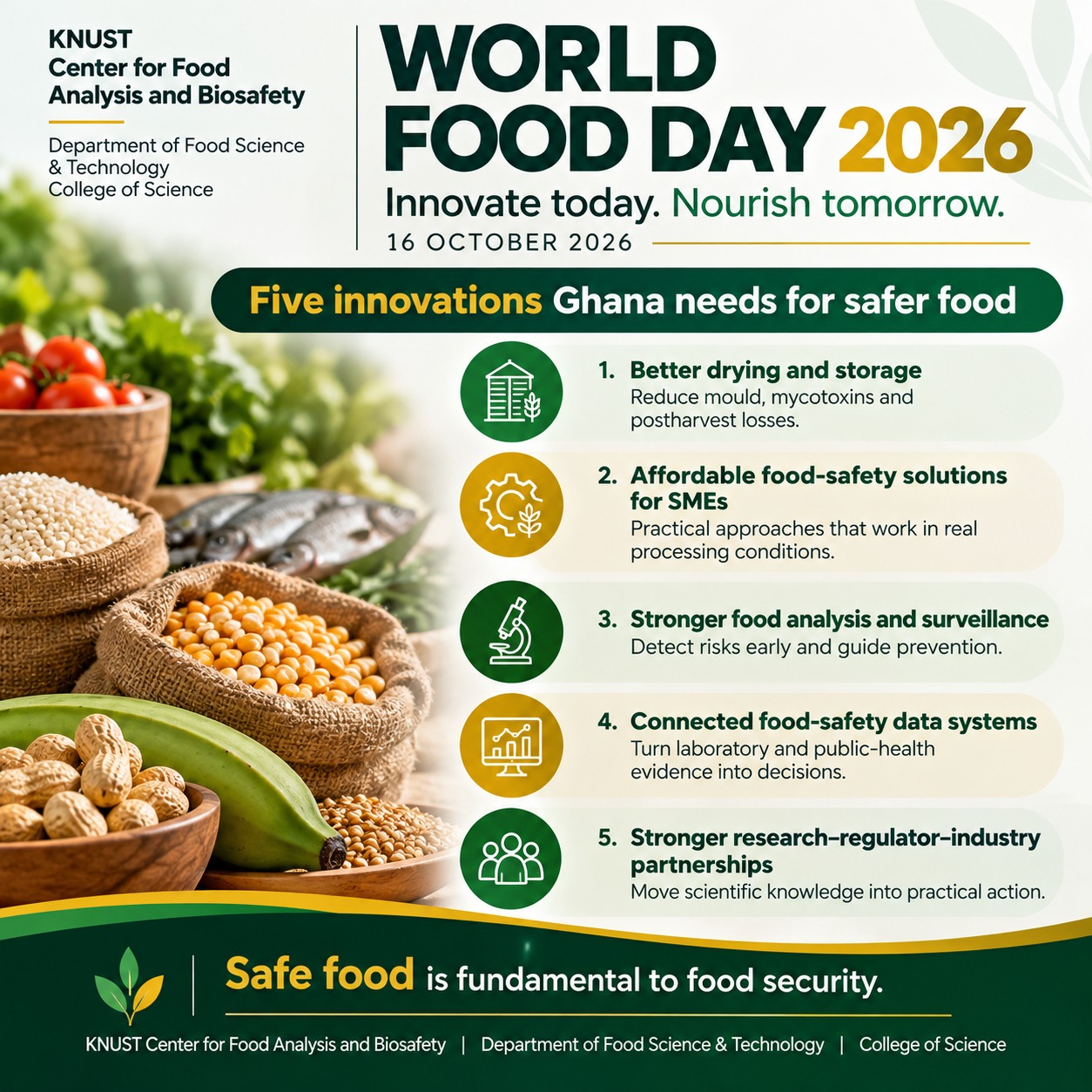
Universities and research institutions have an important responsibility in this transformation. Scientific knowledge must move beyond laboratories and publications into solutions that can be used by food businesses, regulators, farmers, communities and policymakers. Stronger partnerships between academia, government, industry and consumers are therefore essential.
Four priorities for Ghana
• Strengthen national capacity to generate and use reliable food-safety data.
• Support practical and affordable food-safety innovations for small and medium-scale food businesses.
• Build stronger analytical and risk-assessment capability.
• Translate research more rapidly into policy, standards and everyday practice.
The KNUST Center for Food Analysis and Biosafety has been established to contribute to this agenda through interdisciplinary research and evidence generation, professional capacity development, food analysis and biosafety expertise, and the translation of scientific evidence into policy and practice. We look forward to working with public institutions, industry, researchers, development partners and communities to strengthen Ghana’s food system.
World Food Day should remind us that innovation is not an end in itself. Its value lies in whether it helps people live better lives.
As we innovate today to nourish tomorrow, we must ensure that the food of tomorrow is not only more abundant, but also safer, more nutritious and more trusted.
Prof. Herman E. Lutterodt
Center Lead, KNUST Center for Food Analysis and Biosafety
Department of Food Science and Technology | College of Science | KNUST
World Food Day 2026 theme: “Innovate today. Nourish tomorrow.” | FAO, 16 October 2026