Advancing the Sustainable Agenda for Indigenous Food Crops
We are proud to highlight a significant new editorial published in Frontiers in Sustainable Food Systems by our very own Dr. Abena Achiaa Boakye, in collaboration with Prof. Kwaku Gyebi Duodu (University of Pretoria) and Prof. Agnes Mwangwela (Lilongwe University of Agriculture and Natural Resources).
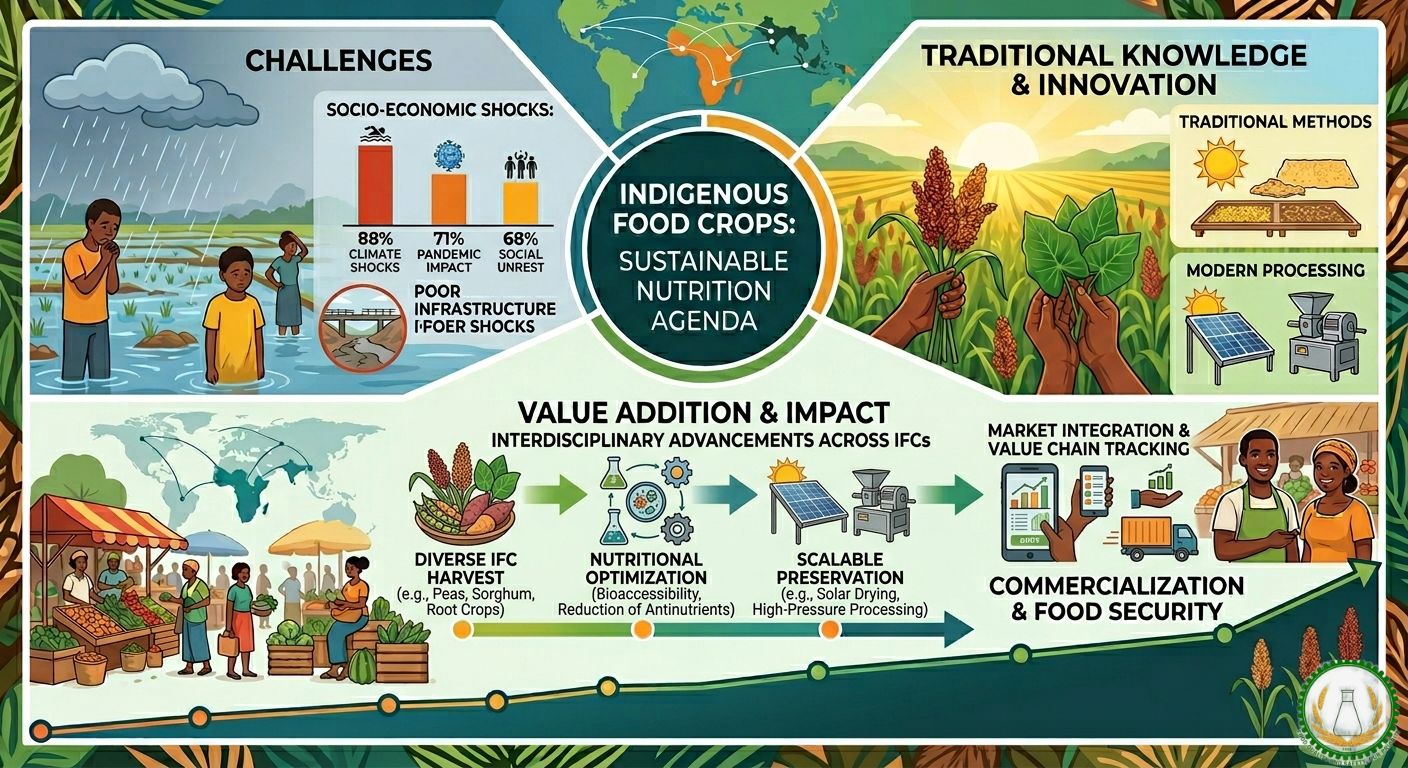
The article, "Processing and Preservation of Indigenous Food Crops: A Sustainable Agenda for Nutrition in the Global South," explores the vital role indigenous food crops (IFCs) play in building resilient and nutrition-sensitive food systems and has already garnered significant interest, recording 235 views shortly after its release. It serves as a keystone publication for a broader Frontiers Research Topic that has achieved notable reach, currently totaling over 39,000 views across its 13 featured articles.
Bridging the Gap Between Tradition and Technology
Dr. Boakye’s work explores the untapped potential of indigenous food crops (IFCs)—such as sorghum, pigeon pea, and cocoyam leaves—to address critical food security challenges. The editorial synthesizes emerging research to demonstrate how modern processing techniques can bridge the gap between traditional knowledge and contemporary nutritional needs.
Key Findings & Research Metrics:
The editorial highlights impactful data from the contributors, emphasizing the efficiency gains and socio-economic hurdles identified in recent studies:
-
Significant Efficiency Gains: Research featured in the collection highlights that simple, optimized processing can yield dramatic results, such as a 66% reduction in cooking time for pigeon peas through effective dehulling methods.
-
Nutrient Retention: Studies demonstrate that combining techniques like blanching and freeze-drying significantly optimizes the retention of proteins and bioactive compounds in leafy greens like cocoyam leaves.
-
Socio-Economic Realities: The work underscores the vulnerability of the IFC sector, noting that vendors face substantial income losses due to external shocks, with studies reporting impact rates as high as 88% due to flooding, 71% due to the COVID-19 pandemic, and 68% due to social unrest.
A Call for Integrated Action
The paper argues that to move IFCs from underutilized resources to staples of the global food system, we must move beyond conceptual advocacy toward scalable, context-specific solutions. This includes integrating traditional knowledge with modern food safety standards, addressing gender-based disparities in value chains, and tackling infrastructure bottlenecks.
This publication underscores our department's ongoing commitment to researching and promoting indigenous African food systems as a key strategy for ensuring food security and economic growth across the continent.
Read the full editorial here: https://www.frontiersin.org/journals/sustainable-food-systems/articles/10.3389/fsufs.2026.1868614/full
Research Articles
We are proud to highlight a significant new editorial published in Frontiers in Sustainable Food
The Department of Food Science and Technology is proud to highlight the international recognition received by its Head of Department, Prof.
A new study led by Prof.
What if one of the most critical ingredients in chocolate could be replaced not with something more complex or imported, but with something grown locally?